The Borg Solution
I've watched organizational mergers and enterprise integrations fail more times than I can count. But the systemic friction is always misidentified.
Two companies combine, but the anticipatory models embedded in their processes, incentives, and cultures were built to predict different futures. A new technology stack lands in an organization built around an older one — e-commerce, then web services, then cloud, now AI — and the informational requirements of the new stack collide with assumptions that made perfect sense before it arrived. Everyone blames data quality or governance, but those aren't the problem. The systems were built to anticipate different worlds, and nobody designed them to learn from each other.
I was talking with my friend Scott not long ago about ecosystem management, and we kept circling back to this dynamic. When previously siloed information systems begin to connect, the integration process reveals knowledge gaps between different parts of the new collective. Information that used to flow cleanly within each silo now collides with incompatible assumptions, and the cascading failures that follow couldn't have been anticipated by any single component.
We know these differentials will appear anytime disparate systems merge. The question is whether the system can metabolize those differences before the mismatch causes metastasis.
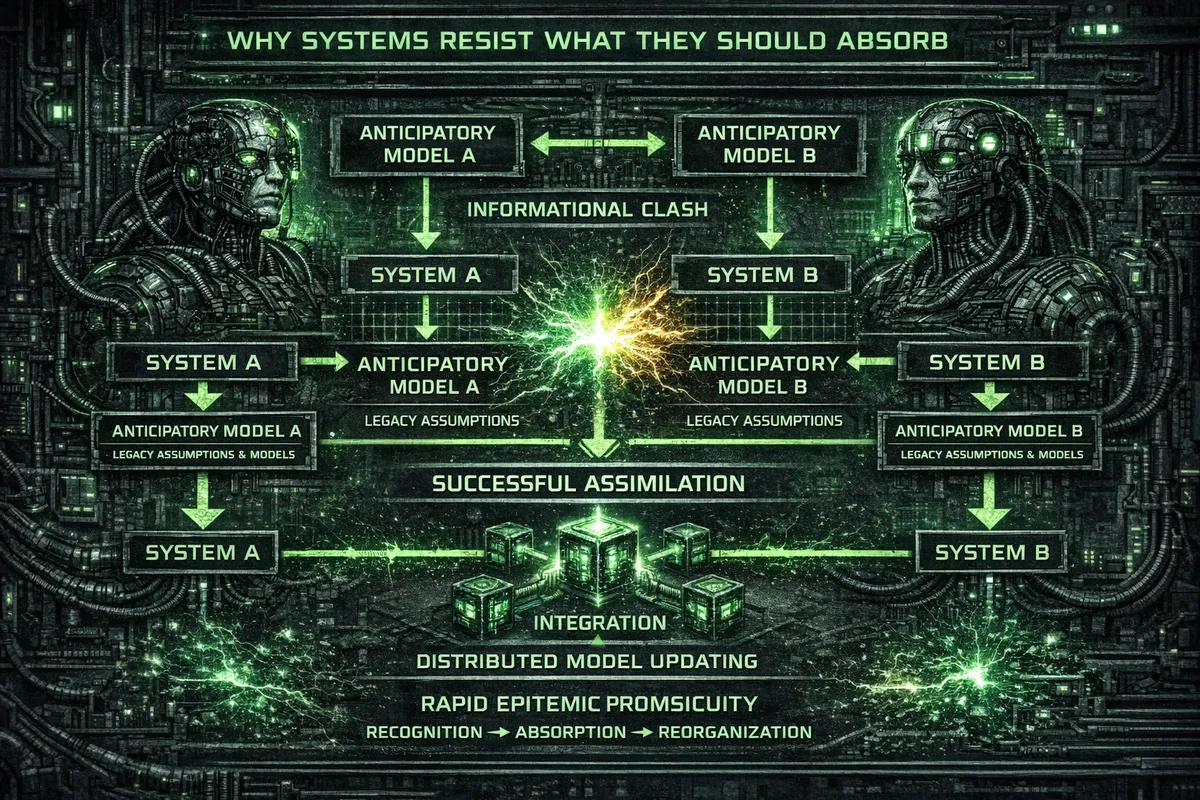
Why Systems Resist What They Should Absorb
Robert Rosen spent his career arguing that living systems are fundamentally different from machines. Machines react to current states. Living systems anticipate; they respond to expected futures because they contain models of themselves and their environment.
When systems merge, the mismatch comes from their respective anticipatory models making different futures visible. Each component is predicting a world that no longer exists, and the gap between what they expect and what's now true is the distance they have to cross to function together. Most can't do it fast enough. New capabilities get rejected or isolated rather than integrated, existing processes calcify around assumptions that no longer hold, and the system loses coherence as different components operate from incompatible models.
A system that successfully absorbs something new does so through countless local updates. Components recognize new patterns, shift resource allocation, and reorganize around novel inputs. No central controller orchestrates this. The adaptation emerges from distributed model updating, each component adjusting its anticipations based on local feedback. But when components can't update fast enough, the differentials cascade faster than local adaptation can absorb them. The system loses coherence and entropy wins.
Nothing Stays Foreign to the Borg
The Borg offer an unexpected model for what successful integration actually looks like.
When the Borg encounter a new species, they don't compete with it, don't try to outmaneuver or destroy it. They assimilate it. Every technology, every adaptation, every capability gets absorbed and integrated into the collective. The Borg are the baddies, but they're also the most effective model of systemic persistence in science fiction. They survive because nothing they encounter stays foreign to them. They recognize what doesn't fit and reorganize around it, and their anticipatory models update continuously.
"Resistance is futile" sounds like a threat, but it's really a statement about model update speed. The Borg don't "react" to new species, in the Rosen sense, they model what those species offer and integrate it before resistance becomes a factor. They solved the distributed update problem with the hive mind: parallel processing of every new encounter, shared instantaneously across the collective.
Most systems don't have that luxury. But the principle still holds.
Designing for Promiscuous Assimilation
This abstracts to any complex information system undergoing integration, whether enterprise architectures, policy regimes, or platform ecosystems. When you merge systems with different knowledge, you need to do more than manage data flows. You have to manage the rate and distribution of model updating across components whose anticipatory structures were never designed to learn from each other.
The differentials that emerge when systems connect aren't problems to minimize. They represent the very model updates you need to help the systems align. So don't try to obscure or minimize them, assimilate them.
The appropriate intervention is designing for rapid, distributed model updating. Making the system epistemically promiscuous, able to recognize and absorb and reorganize around new information before the mismatches compound into collapse.
The Borg persist because they absorb everything they encounter and reorganize around it. Most systems resist that transformation. So most systems don't persist.